
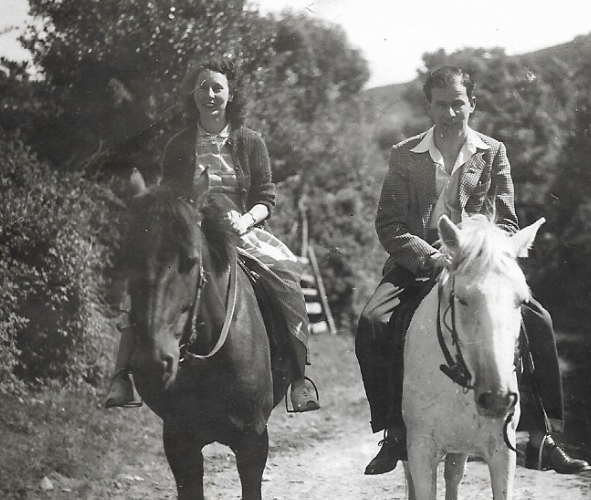
Listen to Myra Levinson’s testimony in her own words.
Myra Levinson (born Myra Benson) 1928- 2021
Myra Levinson (Benson) was born in 1928 in Glasgow and went to the USA, initially for two weeks at the age of 11 but ended up having to stay in the USA for five years. She stayed in Cos Cob in Connecticut, with her aunt and uncle, one of two Jewish families in the town. Her aunt kept a strict Kosher house.
This is my story of how I ended up in America
In 1939 when the second world war was declared, my father’s cousin, Jenny Levine ( Marks) wanted my brother, Harold and I to come to America. There were German planes flying over Glasgow. I was only 11 at that time and my brother said cheerfully that would be a bomb falling . I remember running to my Auntie Eva who lived in Rouken Glen Road ( Glasgow) and the air raid sirens went off. It was so early on in the war, it did not really register with people that there were German planes. My father was at the time Chief Air Raid Warden. He was too old to go into the service
As Harold is five years older and was just about to start medicine he would not go.
Interviewer
Can you tell me your name and where you were born?
Myra Levinson
My name is Myra Levinson. That’s my married name. I don’t know if you want my maiden name.
Interviewer
Oh yeah, no problem.
Myra Levinson
My maiden name was Benson. I was Myra Benson.
Myra Levinson
Born in Glasgow. On 17th of March 1928.
Interviewer
Okay Um, and so I think we’re going to focus on your experiences during the war.
Myra Levinson
Mm-hmm.
Interviewer
And so, do you want to begin by just …
Myra Levinson
Well, I’ll explain when the war broke out.
Myra Levinson
My father’s cousin in America, Jenny Marks or Jenny Levine actually after she was married, um sent word that she would like my brother and myself to come and live in America. Yeah, we had no idea how long the war would last. And my brother was just starting to study medicine so he wasn’t interested. And I was a very naive eleven-year-old and I thought, oh, that sounds fun.
Myra Levinson
I’ll go
Interviewer
Uh-huh.
Myra Levinson
If anybody had said it would be for five years, I wouldn’t have gone. Nobody knew at the time. And um, I flew, I didn’t fly, sorry, went out in a very large ship. on my own
Interviewer
Wow.
Myra Levinson
But uh there was another lady, I can’t remember her name actually, who sort of kept an eye on me. She knew my parents.
Myra Levinson
and it was a very uneventful trip, not knowing that there were ships being torpedoed at the time.
Interviewer
My goodness. How long did it take?
Myra Levinson
It took seven days. When I arrived in New York, um this gentleman said to come with him and he called out over a loudhailer , ” Is there anyone here for Myra Benson?” He called that four or five times. And then he said , ” I just had to check, but you come with me .” You think of it nowadays, you wouldn’t …
Myra Levinson
‘…trot off with an unknown man’ And he took me to a Jewish old age home.
Myra Levinson
And my father’s cousins, I later called aunt and uncle, um they had arranged it, didn’t know when I was arriving, so they thought it’d be safer to be met and they would catch up with me at some time. So I was taken into this old age home and there was a big, big, long trestle table for all those old, old, old, old, old people.
Myra Levinson
and they plonked down a plate of boiled potatoes and smetana which, you know, not for me. And the um matron of the home said, you’ll come stay in my flat tonight or my apartment until family come for you.
Interviewer
Yeah
Myra Levinson
And um we sat outside on the pavement. Well, that’s what people did, they took chairs and sat on the pavements in those days. And I was having an ice cream. Nice.
Myra Levinson
And I looked out and it was very busy. There was a couple walking and I said, I think that couple have come for me. She said, I thought you didn’t know them. I said, I don’t. I just have a feeling they’ve come for me. In my heart.
Interviewer
That’s amazing.
Myra Levinson
and uh went to live in a little town called Cos Cob, Cos Cob, Connecticut. Cos Cob was named after Chief Koskoffian. ( named after the Coe family , later known as Coe’s Cob).
Myra Levinson
And there was one other Jewish family in that uh town, little town. I went to school across the road and very quickly lost my Scottish accent.
Interviewer
really
Myra Levinson
Well, I’d never been to a school that uh was mixed, you know, I was at Hutchie , it was all girls. And I couldn’t get used to the fact that Pardon me.
Myra Levinson
when I was in when I was in the class and someone would say , ” She comes from Scotland .” ‘Oh my God, say something’.
Myra Levinson
And the teacher wanted, made me stand up the first day in school and say ” It’s braw bricht moonlicht nicht tonight”
Interviewer
That’s so funny.
Myra Levinson
I know, I hated it
Interviewer
Myra Levinson
I really did.
Interviewer
Oh my god.
Myra Levinson
But, uh, very homesick naturally to begin with.
Interviewer
Did you have brothers and sisters?
Myra Levinson
Um, no, well my brother stayed here.
Interviewer
Aha.
Myra Levinson
and there were two cousins there, two daughters. One was two years older than I am, and the other one was starting college, she’d already finished school.
Myra Levinson
and my aunt and uncle, call them Jenny and Ben, ran a little newsagents drugstore which was attached to their flat, and they worked twenty-four seven.
Interviewer
My God.
Myra Levinson
They worked so hard. Um, they used to …Sunday, I don’t know if you’ve ever been in America. You know the size of the American papers.
Myra Levinson
They used to get up at five in the morning on a Sunday to fold the papers, you know, to get them all….
Interviewer
Myra Levinson
They really worked terribly hard. Yeah. But I was treated as a daughter. Once I lost my homesickness, you know, I settled down. It took five years.
Interviewer
How long does it take you to feel safe?
Myra Levinson
Um, a few months.
Myra Levinson
She threw out most of my clothes because they didn’t wear such weird clothes as in America. And you want to be the same as everybody else.
Myra Levinson
And that funnily enough was my first time ( I met ) antisemitism. Because the school I went to to begin with, which is just across the road there, as far as that wall really. And I was friendly with a girl who was Italian, of Italian descent. And perhaps I would meet her two or three times a week and all of a sudden she saw me, she turned the other way.
Myra Levinson
I didn’t realise what it was. It’s turned out it was ( because I was ) Jewish. terrible It’s a horrible feeling.
Interviewer
Hey.
Myra Levinson
but um, I was, let’s say I went, I was very happy, went to school, went to high school. Then they switched the lights on here after the war, well, before the war ended.
Interviewer
Mhm
Myra Levinson
the street lights were switched on. So my mother wanted me to go home. (She felt that was) safer.
Myra Levinson
And we, my aunt sent an application, got in touch with whoever she had to, but I wasn’t allowed to tell anybody because the war was still on.
Myra Levinson
And uh got a phone we got a phone call one day I had to go leave the next day so I just left school and never and never to be seen again.
Interviewer
Oh my G-d.
Myra Levinson
And it was weird.
Interviewer
Were you sad to leave?
Myra Levinson
Well I was , cos it was five years, I think you went to eleven, I was nearly … I was just … I was fifteen, just fifteen and a half, you know. Very important, you know, formative years.
Myra Levinson
Speaker Yeah.
Myra Levinson
And the ship sat in the harbour for four days, four or five days. Apart from the ice, they were waiting for a convoy.
Interviewer
Myra Levinson
And my mother apparently kept sending cablegrams Has Myra left?
Interviewer
yeah
Myra Levinson
From Cost Cob. So my aunt thought she won’t say yes because of worry. So she thought it’d be better to say the day I left. which she did. My mother was worried for about two weeks she hadn’t heard.
Interviewer
No
Myra Levinson
Fourteen days to come home and most of the time we slept in our clothes.
Interviewer
Oh my God.
Myra Levinson
Because there were still torpedoes. . Absolutely horrific.
Interviewer
. And when was that that you ….
Myra Levinson
That was nineteen forty-five. Just before the end of the war.
Interviewer
Mhm
Myra Levinson
And I uh we arrived at Liverpool.
Myra Levinson
and were put in a train and those were all closed carriages, there was no corridors. So, and there was a label, see where I was, going from Liverpool to Glasgow.
Interviewer
uh huh.
Myra Levinson
And it seemed to be a long journey and we were so thirsty. We stopped eventually at a station and the WVS. Um, happened to stop at our carriage first and they found all these children dehydrated and dying of the heat.
Interviewer
Myra Levinson
So they emptied all the drinks, kept us going. And when I arrived in Glasgow, got off the train and there was a lady running up the platform. She threw her arms around me and I thought, Oh my God, she’s got the wrong child. It was my aunt.
Myra Levinson
I didn’t recognise her. She’d gone pure white . Now it took a long time to settle down. I wasn’t happy here at all.
Interviewer
Oh, really? Did you stay in touch with people from
Myra Levinson
Oh yes, yes, yes.
Interviewer
Aha
Myra Levinson
They’d never been in holiday ever.
Interviewer
Uh-huh.
Myra Levinson
And excuse me, I wrote at least once a week.
Interviewer
Mhm.
Myra Levinson
And then a couple of years later, I got married.
Interviewer
Mhm
Myra Levinson
And I still corresponded with them. And the letter came one day and before I opened it, and then I said to my husband , ” They are going to come ” He said , ” You haven’t opened the letter !” I said , ” I just know this letter is saying …” I don’t know why.
Interviewer
That’s amazing.
Myra Levinson
They came over here. My mother was so excited because she could repay a little bit of … Yeah. Because after about two years they weren’t allowed to send any money either from here. Okay. So she, uh, you know, did everything, looked after me very well.
Myra Levinson
And she was very Orthodox. Strictly Kosher house. If anything was wrong, she took a fork, whatever it was and stuck it and buried it, you know, I was brought up that way.
Myra Levinson
But to begin with, um, my parents wanted me to continue Cheder.
Interviewer
Mhm
Myra Levinson
So I went, uh, what do they call it? Sunday school. And I was the only one that could read Hebrew.
Interviewer
Myra Levinson
So they wanted me to teach the rest. I said, No. So I never went back.
Interviewer
Myra Levinson
Which was a shame but I was very, very well looked after. Very happy.
Interviewer
Were you … Were you aware of how aware were you of what was happening?
Myra Levinson
to a certain extent, we didn’t know how bad it was. But to begin with, um, you know, as I say, my parents could send money, but after that, that had to stop.
Myra Levinson
And don’t forget, you ‘re 11, after a couple of years you begin to assimilate and you don’t
Interviewer
Totally.
Myra Levinson
Don’t totally take it in.
Interviewer
Of course.
Myra Levinson
I was more interested in finding out what was going on around me. I mean, for instance, probably shouldn’t have be in this. A lady came into the store one day and she started talking to my aunt and she said her water’s broke.
Myra Levinson
And uh after she left, I said to my aunt, she must have had a terrible flood. I was rather naive
Myra Levinson
She put me right on a few things. But it was a it was a lovely wee place to live. Have you ever heard of Greenwich, Connecticut? That’s famous for film stars living there.
Myra Levinson
Interviewer Really
Myra Levinson
Myra Levinson
Myra Levinson
um, that’s where I went to school. And they had, um, which they still have, um, Island Beach. And you took a boat to go to this beach. So, it was great.
Myra Levinson
We had a cabin and we spent weekends going up and down there.
Interviewer
Did you ever go back?
Myra Levinson
I went back for my nephew’s first marriage. I can’t even figure out how long ago that was.
Myra Levinson
Um, oh, it must be about twelve, thirteen years ago or anyway. My nephew’s getting married to her. He was already living in America and uh went to New York to his wedding.
Interviewer
Mhm
Myra Levinson
And I wrote to my cousin who was still living in the same house that that she and her late husband had bought when they were married, and said I was coming. Oh, she was so excited.
Myra Levinson
And I, after the wedding, I went to stay with her for a week. And it was like going back and spit in time. She hadn’t changed anything from the day she was married.
Interviewer
that is super.
Myra Levinson
strange, No, it’s a bit weird actually.
Interviewer
Mhm.
Myra Levinson
The only thing she had done was put in air conditioning in the lounge because she played the piano. The rest, of it was so hot!
Interviewer
Really? Yeah.
Myra Levinson
And she had four children, twin boys and another two. And one of the sons built a fantastic house on her land. She owned and sold so much land round about. They kept in touch with her all the time. Her sister unfortunately died a few years after he came home.
Myra Levinson
And Harriet was in a Home and she only died about two years ago. But I try and keep in touch with her son.
Myra Levinson
And that was my last visit, but when I did go back, we were driving down Greenwich Main Street and I said , ” Oh, that’s where Uncle Irving’s shop was .” And ” Oh, you went down there and that was a Shul and …” Yeah, brought it all back. Brought it all back. Lovely. Old memory lane. Yeah.
Interviewer
Mhm.
Myra Levinson
It also took a long time for me to settle down here.
Interviewer
Yeah, how long did you keep your American accent for?
Myra Levinson
How long did it take?
Interviewer
your accent or when you came back
Myra Levinson
I think I lost it quite quickly because I was very fond of mimicking people.
Interviewer
Oh, okay.
Myra Levinson
To my mother’s disgust. But the first trip I did back, ehm, was staying with a friend of mine.
Myra Levinson
Um, we went to a hotel called Grossinger’s which is a big Jewish hotel. And Harriet and her husband came through to stay for the weekend with us, you know, it was lovely. First time I had seen them.
Myra Levinson
And uh, that was very memory lane when when we did this and when we did that. It was lovely.
Myra Levinson
Then there was the next trip was, uh, as soon as my nephew got married. I’ve no, I’ve no desire to go back now.
Interviewer
Yeah.
Myra Levinson
It’s all too much.
Interviewer
Um, you told me about one experience, your first experience of antisemitism. Did you have any other while you were in America?
Myra Levinson
I personally didn’t, even though the other family were also at the school. But the only thing, um, in class one day, American children never, well they probably do it now too, the habit of talking to the teacher and telling them what was, you know. But we sat, and one boy was saying, oh yeah, he was walking in Central Park and all these old Jew men were sitting there and I I just felt my tummy going. Whether they knew I was Jewish or not, I don’t know. I don’t think so because there was only two of us in the whole school.
Interviewer
Yeah, so you don’t think most people knew.
Myra Levinson
I don’t think they knew, and it wasn’t anything. I mean, I was always off for the Jewish holidays, but uh, I don’t think anyone really bothered.
Interviewer
Mhm
Myra Levinson
But that’s why my aunt and uncle were very keen that her daughters went to college because they wouldn’t meet, um, Jewish boys if they stayed where they were. Yeah. So they both married.
Myra Levinson
no longer with us, any of them. Sad.
Interviewer
Yeah.
Myra Levinson
Hmm. But it was so thrilling when they came over here.
Myra Levinson
My husband took a week off work and took them all over. Drove them all over Scotland. And he said to them , ” You’ve come so far, you must go to Israel .”
Myra Levinson
which he arranged everything for them. And after they left, I said, I’ve never been to Israel!
Myra Levinson
We went the following month. Which was wonderful. Yeah. have you been?
Interviewer
Aha
Myra Levinson
wonderful
Interviewer
Not for , years, but yeah, I loved it. Yeah.
Myra Levinson
It still got something. Yeah. You step off the plane and you’re home.
Interviewer
Uh-huh , ’cause did you feel not fully at home in America or Glasgow or but when you went to Israel you felt … Yeah, yeah, definitely.
Myra Levinson
Yeah, you know,do you not feel that.
Interviewer
Yeah, I feel like I belong. Yeah
Myra Levinson
Interviewer
Interesting, yeah.
Myra Levinson
But uh, as I say when I came back, I was very unsettled.
Interviewer
No wonder
Myra Levinson
Don’t forget I missed the last few years of schooling.
Interviewer
did you when you got home?
Interviewer
Myra Levinson
Yes I refused to go back to school.
Interviewer
Did you when you got home?
Myra Levinson
Yes, it was completely different.
Interviewer
course
Myra Levinson
When I first started, I’m going backwards actually, when I first started going to school there, every week they had a class test.
Interviewer
Hmm.
Myra Levinson
And it was, ‘I am going to school ‘or ‘I ain’t going to school’ This is the sort of questions. Apart from anything else I had done all the work. So for two years I did absolutely nothing.
Interviewer
my goodness
Myra Levinson
So when I went to the high school, I had to do a bit of work, but I couldn’t be bothered. And then I came back to this country and I couldn’t even understand the uh currency. It was pounds, shillings and pence.
Myra Levinson
And I went to college to find out how to do long division with pounds, shillings and pence. I was used to working in tens and dimes. Yeah. Which we are now, but at the time it was very hard.
Interviewer
Of course.
Myra Levinson
And the first trip I did go back to America, my girlfriend was laughing because she said I had two feet off the plane and my accent came back.
Interviewer
Really? That’s funny. Hmm, were you not even conscious of it?
Interviewer
Myra Levinson No
Interviewer
That’s amazing.
Interviewer
That’s funny.
Myra Levinson
We went to this Jewish hotel, Grossingers, and when it was really for young people, I don’t think there was any married people there… a big big singles hotel, you know. And talking, and as soon as they said , ” They come from Scotland ,” ” Oh my God !” And Jewish people , ” Are there any Shuls there? And what did they do ?” And some were very, very Frum, some weren’t, and it was really quite funny. Felt like printing out a list and saying , ” Here .”
Myra Levinson
And I got married and that’s it.
Interviewer
Amazing.
Myra Levinson
Um, but it wasn’t, it was because of the war that I went there. Yeah.
Interviewer
But you didn’t feel a massive impact of the war over there?
Myra Levinson
Well then don’t forget America went into the war.
Interviewer
Quite late
Myra Levinson
Interviewer
Were you aware when that started happening when they joined?
Myra Levinson
Oh yes, I knew what was going on and coming back, as I said, it took fourteen days to come back and sleep in our clothes was not
Interviewer
Aha.
Myra Levinson
quite frightening
Interviewer
it’s different
Myra Levinson
But um it’s difficult, you have to remember five years between eleven and fifteen or maybe eleven to sixteen are very informative years.
Interviewer
completely
Myra Levinson
took me a long, yes, took me a long time to settle down.
Interviewer
Yeah, that’s uh-huh.
Myra Levinson
And then I met my husband-to-be. That settled me down.
Interviewer
Yeah, I bet. And it’s amazing experience too.
Myra Levinson
Mhm, but I was lucky.
Interviewer
Yeah. How did your brother feel about you having gone away and he didn’t go?
Myra Levinson
There’s five years between us and because he was studying , studying medicine, I was still at school. When I was very young, when I was first born, he was very jealous, which he grew out of it eventually. So, I was away for five years. When I came back, he’d by now finished his studies and had gone into the army, which they had to do.
Interviewer
Myra Levinson
and he decided …..that’s when the National Health Service started.
Interviewer
Hmm.
Myra Levinson
He decided to sign on for an extra year, much to my mother’s horror. When he came back I was already married with a child.
Interviewer
Oh my goodness.
Myra Levinson
So it was too many years apart. Now, of course. But um then he got married in England and uh, you know, he sort of drifted a bit. Yeah, very close now.
Interviewer
Aha.
Myra Levinson
I’m going to be seeing him on Tuesday. Grandson’s wedding?
Interviewer
Oh, that’s lovely. Mazal tov
Myra Levinson
And that’s the story of my life.
Interviewer
and it just and you managed, it was okay with your mother? I mean it must have been strange.
Myra Levinson
It’s very hard for them. very, very hard As a matter of fact, I have a neighbor who lives downstairs.
Myra Levinson
I don’t want to say her name because it’s not fair. But we have a similar shaped mouth. That was about the only thing we found that, uh, started this. Every time my mother saw her, she started to cry.
Interviewer
Oh my goodness. Oh, your poor mother.
Myra Levinson
Poor Joan She didn’t know why my mother was crying.
Myra Levinson
But there must be something because a non Jewish friend…..I went into the hairdresser’s a few years ago and she went up to this girl and asked her if she was any relation to me.
Interviewer
Really.
Myra Levinson
And she’d never seen her before. Thank you. It must be something then.
Myra Levinson
Um, it did take a long time to settle down. I wasn’t happy. First of all, food rationing here.
Interviewer
Of course.
Myra Levinson
And I wasn’t used to that. And when we had a steak, it was a steak.
Interviewer
Myra Levinson
came back, my mother had a little steak one day. I thought, You call that a steak .
Interviewer
Oh my gosh.
Myra Levinson
horrible
Interviewer
It’s been so hard for both of you.
Myra Levinson
It was hard. I really wasn’t happy.
Interviewer
Yeah.
Myra Levinson
But yeah, gradually. You get used to it.
Interviewer
Myra Levinson
I actually, if I hadn’t met my husband, I think I would have moved back to the States.
Interviewer
Myra Levinson
Because I went, I didn’t go as an evacuee. I didn’t know this. I had to go the first week, ten days after I arrived, I had to go to the police station every day.
Myra Levinson
until um forget it. And I found out afterwards I didn’t go out as an evacuee, I went out as an immigrant.
Interviewer
Oh. emigrated…
Myra Levinson
And I could have, um, taken American nationality with no problem. Amen. So, all is ordained, isn’t it?
Interviewer
And how did you meet your husband?
Myra Levinson
we belong to the Glasgow Jewish Board of Guardians Committee.
Interviewer
oh Yeah.
Myra Levinson
And uh, took it from there.
Interviewer
Myra Levinson
Used to meet in oh down, oh, gone blank , the old Board of Guardians place, Copelaw Street.
Myra Levinson
And so we used to meet once a week. And then I don’t know if you’ve ever heard of Geneen’s Hotel.
Interviewer
No.
Myra Levinson
Wellthat was only Jewish Hotel in the Gorbals
Interviewer
Yeah.
Myra Levinson
And as a matter of fact, it was her daughter-in-law Flo that I became very friendly with . When I became a widow, she was already a widow. So we used to go on holiday together. Mrs. Geneen had the Jewish Hotel and every Sunday after the meeting of the Board of Guardians, we all trotted over to Geneens for something to eat . And that’s how we met..
Myra Levinson
And it just went from there.
Interviewer
Yeah.
Myra Levinson
That’s how we how we met.
Interviewer
And did you experience any antisemitism in Glasgow after the war?
Myra Levinson
Uh, no, I tell you the strange thing because I wasn’t mixing with any Jewish people. I was quite happy going out on a date with a non-Jewish boy.
Interviewer
Mhm
Myra Levinson
just literally a date picture, so there’s nothing else. But when I came home, I wouldn’t go
Myra Levinson
Really?
Myra Levinson
I don’t know, it just complete no, but otherwise I’d never have gone out because there was nobody. The other family
Interviewer
Myra Levinson
No, there there was one other family ( he was a horror) Howard Hoffman, I remember his name.
Interviewer
Laughs
Myra Levinson
But um, otherwise I’d have just sat home day in and day out.
Interviewer
Exactly.
Myra Levinson
As soon as I came home, I wouldn’t do it. It just never occurred to me. Maybe it’s just as well I came home.
Interviewer
Aha. Yeah.
Interviewer
Yeah. Um, I think so. Is there anything else that you really want to talk about? Ehm, your post-war years or before you went to America?
Myra Levinson
Sorry pardon
Interviewer
Is anything after after the war or before you went to America that you feel you want to talk about ?
Myra Levinson
No, not really. Went to school. And I um I’ve always done voluntary work within the Jewish Old Age Home.
Interviewer
Ooh yeah.
Myra Levinson
And I’m still doing it.
Interviewer
It’s amazing.
Myra Levinson
And with the highs for me …I would say family.
Interviewer
Hi
Myra Levinson
and Judaism is significant in my life.
Myra Levinson
That’s it.
Interviewer
that was great.
Myra Levinson
So, I mean, I was born here, that’s slightly different from some of the people you’re going to interview.
Interviewer
Yes well that’s good, We want …… the variety, brilliant
Interviewer
Myra Levinson
. I’ll provide that.
Interviewer
That was great. Thank you.