
The Interactive Exhibition
The Gathering the Voices Exhibition is a dedicated resource designed to share powerful stories with communities and schools across Scotland and beyond. By bringing these histories into a digital space, the exhibition provides an immersive way to explore the lives of those who escaped Nazi persecution.
1. Before the war – the 1930s
Explore the Exhibition
Click the + markers on each picture to discover stories. Select any marker to open a story card.
All 10 stories on this board, as a list
-
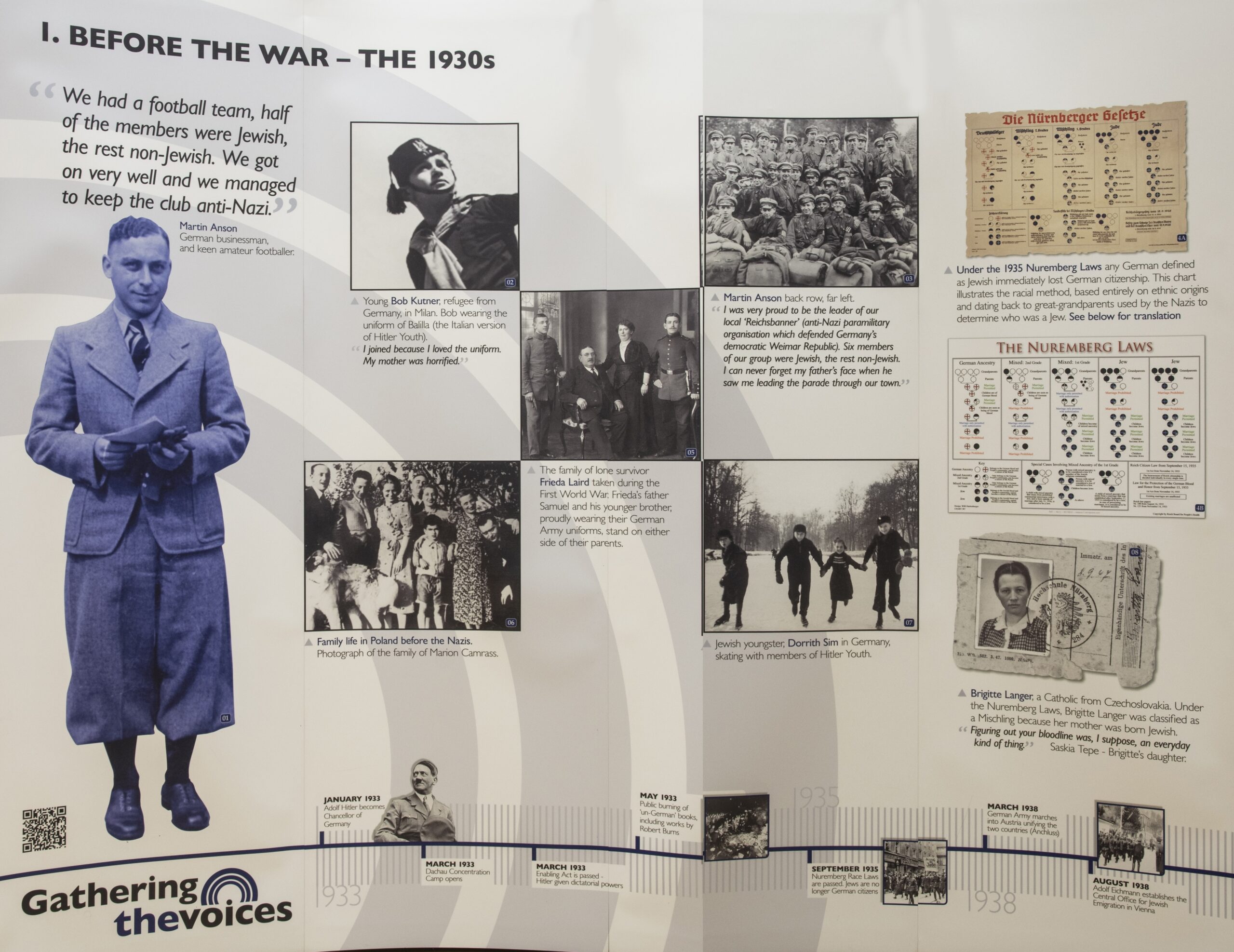
Martin Anson
We had a football team, half of the members were Jewish, the rest non-Jewish. We got on very well and we managed to keep the club anti-Nazi.
-
Bob Kutner
Young Bob Kutner, refugee from Germany, in Milan. Bob wearing the uniform of Balilla (the Italian version of Hitler Youth).
"I joined because I loved the uniform. My mother was horrified."
-
Brigitte Langer
Brigitte Langer a Catholic from Czechoslovakia. Under the Nuremberg Laws, Brigitte Langer was classified as a Mischling because her mother was born Jewish.
Figuring out your bloodline was, I suppose, an everyday kind of thing. — Saskia Tepe - Brigitte's daughter.
-
Die Nürnberger Gesetze
1935
Under the 1935 Nuremberg Laws any German defined as Jewish immediately lost German citizenship. This chart illustrates the racial method, based entirely on ethnic origins and dating back to great-grandparents used by the Nazis to determine who was a Jew. See below for translation
-
Dorrith Sim
Jewish youngster, Dorrith Sim in Germany, skating with members of Hitler Youth.
-
Frieda Laird
The family of lone survivor Frieda Laird taken during the First World War. Frieda's father Samuel and his younger brother, proudly wearing their German Army uniforms, stand on either side of their parents.
-
The Nuremberg Laws
This image displays a translated informational chart of the 1935 Nuremberg Laws, a central piece of anti-Semitic legislation enacted by Nazi Germany.
It illustrates the regime's pseudo-scientific racial classifications based on a person's grandparents, dividing individuals into categories like "German Ancestry," "Mixed," and "Jew."
The chart explicitly outlines how these specific classifications dictated severe restrictions on civil rights, citizenship, and permitted marriages in an effort to enforce "racial purity."
-
Martin Anson
" I was very proud to be the leader of our local ‘Reichsbanner’ (anti-Nazi paramilitary organisation which defended Germany’s democratic Weimar Republic). Six members of our group were Jewish, the rest non-Jewish. I can never forget my father’s face when he saw me leading the parade through our town. "
-
Marion Camrass
Photography of the family of Marion Camrass
-
The Holocaust timeline
See the history behind the testimonies. Explore our step-by-step timeline of the Holocaust if you want to find out more about the events that shaped these stories.
2. From Kristallnacht to World War
All 8 stories on this board, as a list
-
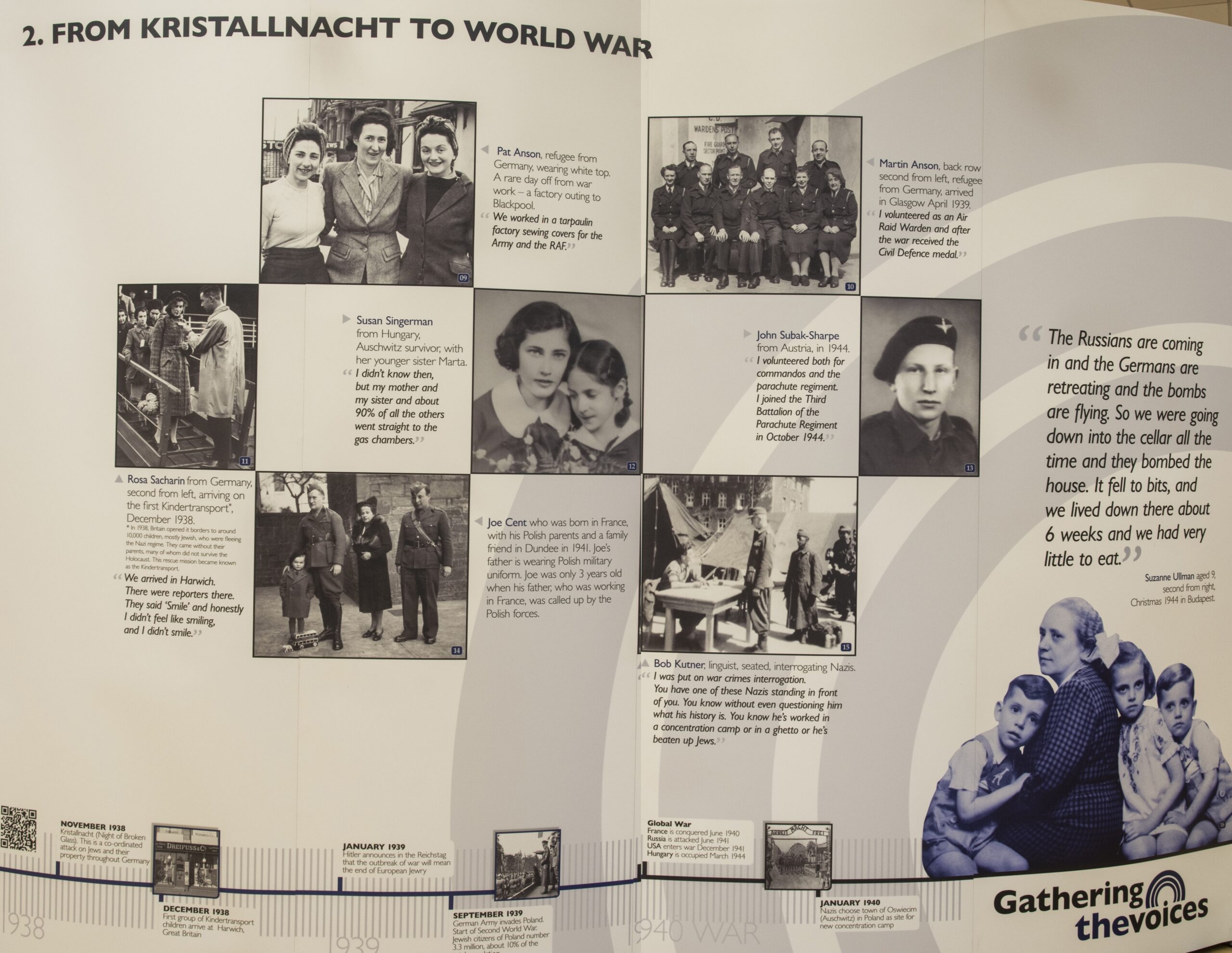
Rosa Sacharin
Germany
In 1938, Britain opened it borders to around 10,000 children, mostly Jewish, who were fleeing the Nazi regime. They came without their parents, many of whom did not survive the Holocaust. This rescue mission became known as the Kindertransport.
We arrived in Harwich. There were reporters there. They said ‘Smile’ and honestly I didn’t feel like smiling, and I didn’t smile.
-
Pat Anson
Pat Anson, refugee from Germany, wearing white top. A rare day off from war work – a factory outing to Blackpool.
“We worked in a tarpaulin factory sewing covers for the Army and the RAF.”
-
Susan Singerman
Susan Singerman from Hungary, Auschwitz survivor, with her younger sister Marta.
“I didn’t know then, but my mother and my sister and about 90% of all the others went straight to the gas chambers.”
-
Joe Cent
France
Joe Cent who was born in France, with his Polish parents and a family friend in Dundee in 1941. Joe’s father is wearing Polish military uniform. Joe was only 3 years old when his father, who was working in France, was called up by the Polish forces.
-
Bob Kutner
“I was put on war crimes interrogation. You have one of these Nazis standing in front of you. You know without even questioning him what his history is. You know he’s worked in a concentration camp or in a ghetto or he’s beaten up Jews.”
-
Martin Anson
“I volunteered as an Air Raid Warden and after the war received the Civil Defence medal.”
-
John Subak-Sharpe
“I volunteered both for commandos and the parachute regiment. I joined the Third Battalion of the Parachute Regiment in October 1944.”
-
Suzanne Ullman
“The Russians are coming in and the Germans are retreating and the bombs are flying. So we were going down into the cellar all the time and they bombed the house. It fell to bits, and we lived down there about 6 weeks and we had very little to eat.”S
3. Refugee journeys
All 10 stories on this board, as a list
-
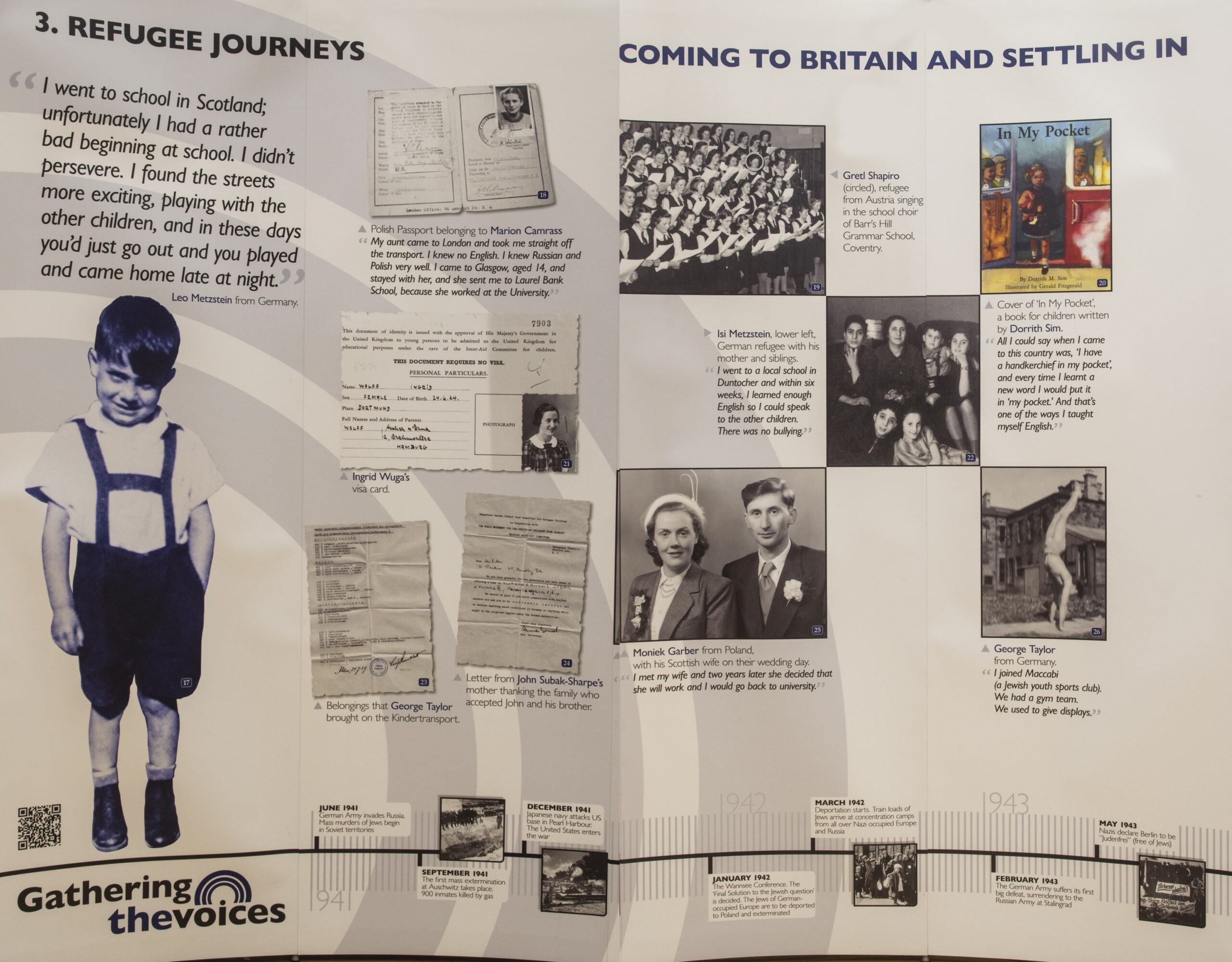
Refugee Journeys
I went to school in Scotland; unfortunately I had a rather bad beginning at school. I didn't persevere. I found the streets more exciting, playing with the other children, and in these days you'd just go out and you played and came home late at night.
-
Marion Camrass
"My aunt came to London and took me straight off the transport. I knew no English. I knew Russian and Polish very well. I came to Glasgow, aged 14, and stayed with her, and she sent me to Laurel Bank School, because she worked at the University."
-
Gretl Shapiro
Gretl Shapiro (circled), refugee from Austria singing in the school choir of Barr's Hill Grammar School, Coventry.
-
Isi Metzstein
"I went to a local school in Duntocher and within six weeks, I learned enough English so I could speak to the other children. There was no bullying."
-
Moniek Garber
Moniek Garber from Poland, with his Scottish wife on their wedding day.
"I met my wife and two years later she decided that she will work and I would go back to university."
-
George Taylor
I joined Maccabi (a Jewish youth sports club). We had a gym team. We used to give displays.
-
In My Pocket by Dorrith M. Sim
All I could say when I came to this country was, 'I have a handkerchief in my pocket', and every time I learnt a new word I would put it in 'my pocket.' And that's one of the ways I taught myself English.
Cover of 'In My Pocket', a book for children written by Dorrith Sim.
-
Ingrid Wuga
-
George Taylor
-
John Subak Sharpe
4. Reflections
All 12 stories on this board, as a list
-
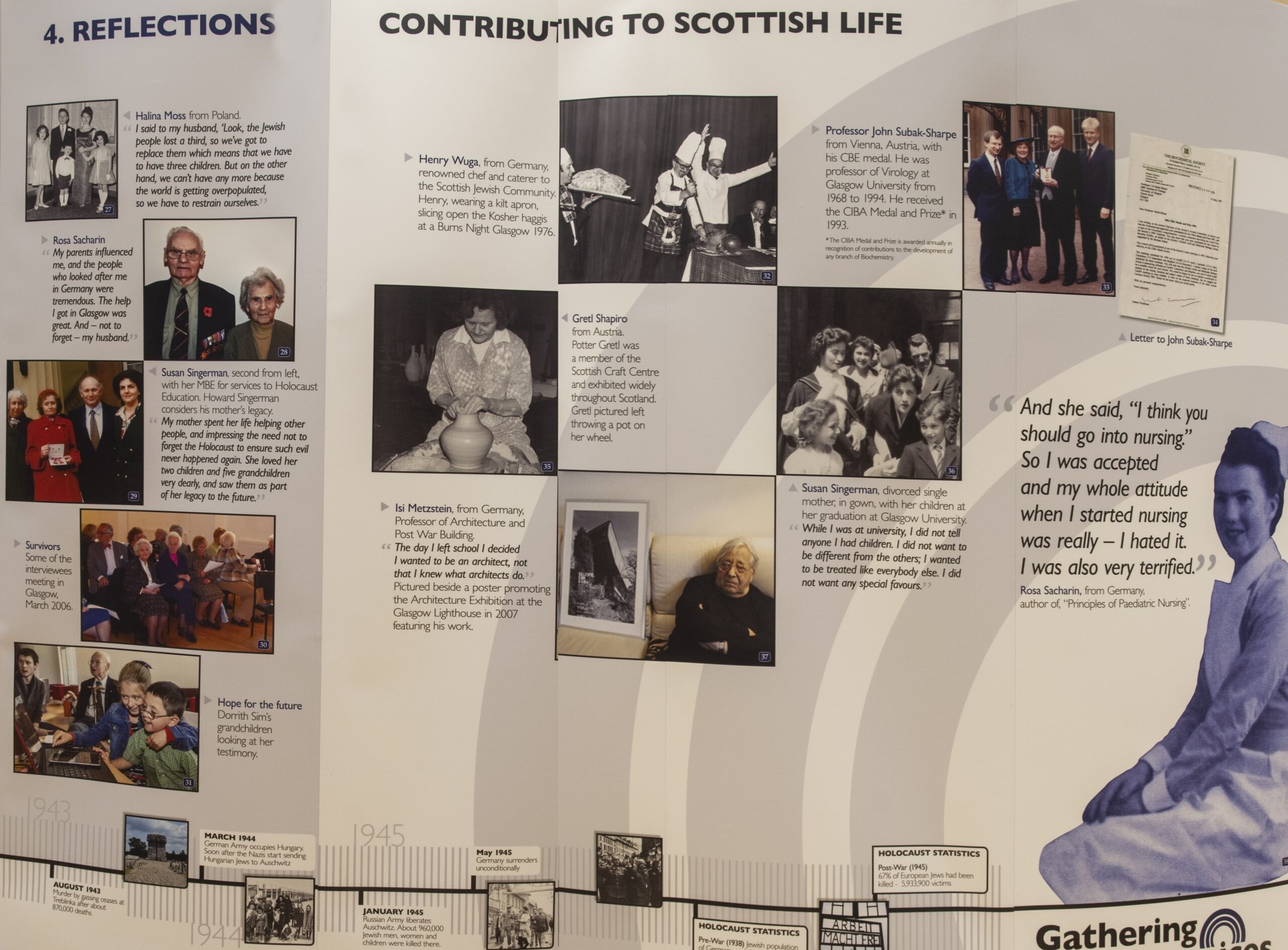
Halina Moss
Poland
I said to my husband, 'Look, the Jewish people lost a third, so we've got to replace them which means that we have to have three children. But on the other hand, we can't have any more because the world is getting overpopulated, so we have to restrain ourselves.
-
Rosa Sacharin
And she said, “I think you should go into nursing.” So I was accepted and my whole attitude when I started nursing was really – I hated it. I was also very terrified." — Rosa Sacharin, from Germany, author of, “Principles of Paediatric Nursing"
-
Henry Wuga
Henry Wuga, from Germany, renowned chef and caterer to the Scottish Jewish Community. Henry, wearing a kilt apron, slicing open the Kosher haggis at a Burns Night Glasgow 1976.
-
Gretl Shapiro
Gretl Shapiro from Austria. Potter Gretl was a member of the Scottish Craft Centre and exhibited widely throughout Scotland. Gretl pictured left throwing a pot on her wheel.
-
Isi Metzstein
Isi Metzstein, from Germany, Professor of Architecture and Post War Building. Pictured beside a poster promoting the Architecture Exhibition at the Glasgow Lighthouse in 2007 featuring his work.
"The day I left school I decided I wanted to be an architect, not that I knew what architects do."
-
Susan Singerman
Susan Singerman, divorced single mother, in gown, with her children at her graduation at Glasgow University.
"While I was at university, I did not tell anyone I had children. I did not want to be different from the others; I wanted to be treated like everybody else. I did not want any special favours."
-
Professor John Subak-Sharpe
Professor John Subak-Sharpe from Vienna, Austria, with his CBE medal. He was professor of Virology at Glasgow University from 1968 to 1994. He received the CIBA Medal and Prize* in 1993.
*The CIBA Medal and Prize is awarded annually in recognition of contributions to the development of any branch of Biochemistry.
-
Rosa Sacharin
"My parents influenced me, and the people who looked after me in Germany were tremendous. The help I got in Glasgow was great. And – not to forget – my husband."
-
Susan Singerman
Susan Singerman, second from left, with her MBE for services to Holocaust Education. Howard Singerman considers his mother's legacy.
"My mother spent her life helping other people, and impressing the need not to forget the Holocaust to ensure such evil never happened again. She loved her two children and five grandchildren very dearly, and saw them as part of her legacy to the future."
-
Meeting in Glasgow
2006
Some of the interviewees meeting in Glasgow, March 2006.
-
Rosa Sacharin
"And she said, “I think you should go into nursing.” So I was accepted and my whole attitude when I started nursing was really – I hated it. I was also very terrified." Rosa Sacharin, from Germany, author of, “Principles of Paediatric Nursing”.
-
Survivors
2006
Some of the interviewees meeting in Glasgow, March 2006.
The Holocaust timeline
See the history behind the testimonies. Explore our step-by-step timeline of the Holocaust if you want to find out more about the events that shaped these stories.
View the Timeline